# Some Models Are Flashy. Some Models Are Forever.
Table of Contents
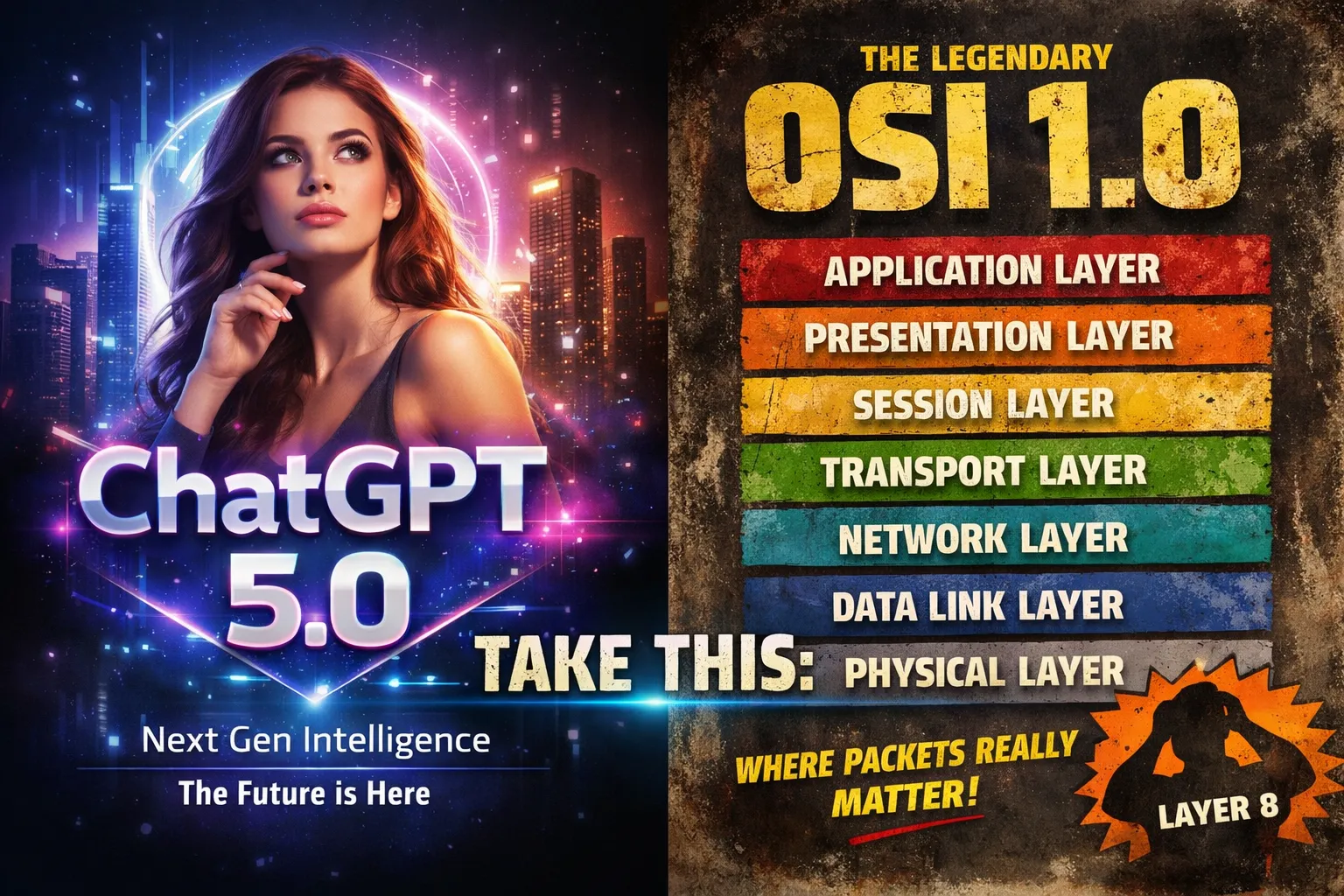 Every few months, the industry discovers the next model.
This time it’s
Gemini 3 Pro Ultra Whatever™.
Next time it’s 3.5, and suddenly we’re back to
“human race extinction is imminent.”
Same movie. New trailer.
Benchmarks go up.
Slides get cleaner.
Threads declare “this changes everything” before the weights even finish uploading.
And just like that, the timeline resets.
New year. New model. Same prophecy.
The part everyone forgets
What the industry conveniently forgets
or never learned in the first place
is that none of this runs in a vacuum.
Most “vibe coders” have never heard of the OSI Model.
Not because it’s outdated.
Because it’s boring.
No hype cycle.
No launch event.
No extinction countdown.
Yet this unsexy, decades-old abstraction
is still quietly holding the entire internet together.
The longest-running model in tech
Packets still move.
Failures still cascade at Layer 1–3.
Latency still ruins your “AI-native” demo.
And debugging still begins with:
“Is the network actually up?”
The OSI Model doesn’t get rebranded.
There is no OSI 3.5.
No OSI Pro Max.
It doesn’t promise to replace humans.
It just ensures your miracle model can talk to anything at all.
OSI isn’t alone
The OSI Model isn’t special because it’s old.
It’s special because it never needed rebranding.
And it’s not the only one.
Modern systems quietly run on models most hype-driven engineers never name: consistency tradeoffs, failure domains, queueing behavior, latency budgets, organizational incentives.
They don’t trend. They don’t ship with release notes. They don’t care how smart the next model is.
They just describe reality.
You don’t replace these models. You inherit them.
Yet everything depends on them.
- CAP Theorem – pick two, live with the third
- ACID – because data loss isn’t a “temporary inconvenience”
- Amdahl’s Law – your AI won’t fix the slow part you ignored
- Latency budgets – physics still clocks your ambition
- Queueing theory – why your “agent swarm” collapses under load
- Failure domains – why one smart model can still take everything down
Intelligence doesn’t bypass physics
Every year, we announce a new intelligence revolution.
Every year, we forget the same fundamentals.
Models get smarter.
Reality stays stubborn.
Your system still:
- times out
- drops packets
- fails under load
- breaks at Layer 8
Some models are flashy. Some models are forever.
The future may be intelligent.
It may reason.
It may generate code faster than you can read it.
But it will still run on networks.
It will still fail in mundane ways.
And it will still depend on models that never trend on social media.
Some models chase headlines.
Some models just keep the world running.